
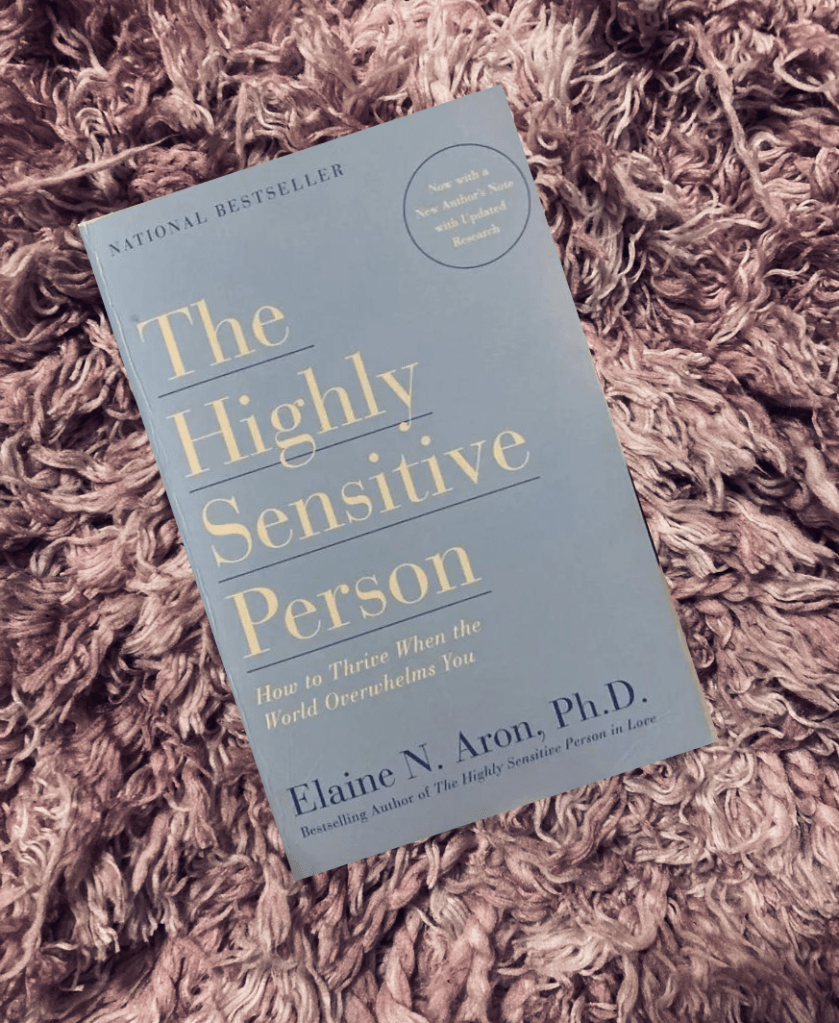
Author’s Note, 2012
- HSP can be defined using DOES acronym
- D =depth of processing. Our fundamental characteristic is that we observe and reflect before we act. We process everything more than others do, whether we are conscious of it or not
- O = over-stimulated; if you are going to pay more attention to everything, you are bound to tire sooner
- E = giving emphasis to our emotional reactions and having strong empathy, which among other things motivates us to notice and learn
- S = being sensitive to all the subtleties around us
- HSP trait could be related to a variation in genetics that determines serotonin levels in the brain. Could also be associated with dopamine. Regardless, genes governing high sensitivity are real
- HSPs are typically more sensitive to their environments, pay attention, have developed a survival strategy of pausing to check, observe, reflect, process what has been noticed before taking action
- When a past experience was very bad, an HSP can overgeneralize and avoid or feel anxious in too many situations, just because the new ones resemble in some small way the past bad one
- The brains of the highly sensitive do tend to elaborate sensory input more thoroughly
- Research has shown more brain activation in HSPs than in others in an area called the insula, a part of the brain that integrates moment-to-moment knowledge of inner states and emotions, bodily position, and outer events
- Mirror neurons: when we humans are watching someone else do something or feel something, this clump of neurons fires in the same way as some of the neurons in the person we are observing
- Example: the same neurons fire, to varying degrees, whether we are kicking a soccer ball, see someone else kicking a soccer ball, hear the sound of someone kicking a soccer ball, or hear or say the word kick
- Not only do these amazing neurons help us learn through imitation, but in conjunction with the other areas of the brain associated with empathy that were also shown in this study to be especially active for HSPs, the mirror neuron area helps us know others’ intentions and how they feel
- Hence they are thought to be partly responsible for the universal human capacity for empathy
- Perhaps these mirror neurons, if they help us know others’ intentions, allow us to get the intuitive sense about people and have the ability to know quickly if they are honest and trustworthy –> better judge of character/more intuitive
- But the actual research has placed emotion at the center of wisdom
- Perhaps everyone reacts strongly to negative situations, but maybe HSPs have evolved so that we especially relish a good outcome and figure out more than others how to make it happen
- “emotional leader”
- Process sensory information more carefully
- The brain areas that are more active when sensitive people perceive are those that do the more complex processing of sensory information
- Negative emotions are greatly decreased by personality qualities or skills labeled together as part of the trait of mindfulness: nonreactivity, nonjudging, acceptance, ability to describe feelings, and acting with awareness.
- Anxiety is lower in HSPs with this trait, particularly when we have the quality of acceptance.
- Depression that occurs when there is less sun, in winter or areas prone to clouds or rain – many HSPs have Seasonal Affective Disorder
- Not every HSP; just more common in us
- Depression that occurs when there is less sun, in winter or areas prone to clouds or rain – many HSPs have Seasonal Affective Disorder
- Not every HSP; just more common in us
- HSPs were more likely to see sex as having a quality of mystery or power; to have difficulty returning abruptly to ordinary activities after sex; and be less aroused than others by strong, explicit sexual cues
- The following two items were true for all HSPs, but especially for men: “Liking to have things be the same each time you have sex” and not particularly enjoying variety in sexual activities
- Such leaders tend to “say and do the right things at just the right time. This isn’t luck or magic, it’s their innate ability to feel deeply, process richly, and patiently consider the right words and actions for the moment”
Preface
- As an adult, it has probably been harder to find the right career and relationships and generally to feel self-worth and self-confidence
- (HSPs sometimes think things over for a while before making their move!)
1 – The Facts About Being Highly Sensitive
The Good News and the Not-So-Good
- What this difference in arousability means is that you notice levels of stimulation that go unobserved by others
- This is true whether we are talking about subtle sounds, sights, or physical sensations like pain
- It is not that your hearing, vision, or other senses are more acute (plenty of HSPs wear glasses)
- The difference seems to lie somewhere on the way to the brain or in the brain, in a more careful processing of information. We reflect more on everything. And we sort things into finer distinctions
- Transmarginal inhibition: shutdown point after too much arousal
- What is moderately arousing for most people is highly arousing for HSPs
- First discussed by Russian physiologist Ivan Pavlov, who was convinced that the most basic inherited difference among people was how soon they reach this shutdown point and that the quick-to-shut-down have a fundamentally different type of nervous system
More About Stimulation
- Often we can get used to stimulation. But sometimes we think we have and aren’t being bothered, but suddenly feel exhausted and realize why: We have been putting up with something at a conscious level while it was actually wearing us down.
- Even a moderate and familiar stimulation, like a day at work, can cause an HSP to need quiet by evening.
- At that point, one more “small” stimulation can be the last straw
Your Trait Really Does Make You Special
- Most HSPs are:
- Better at spotting errors and avoiding making errors
- Highly conscientious
- Able to concentrate deeply (but we do best without distractions)
- Especially good at tasks requiring vigilance, accuracy, speed, and the detection of minor differences
- Able to process material to deeper levels of what psychologists call “semantic memory”
- Often thinking about our own thinking
- Able to learn without being aware we have learned
- Deeply affected by other people’s moods and emotions
2 – Digging Deeper
The Brain’s Two Systems
- Is it easy for you to be content with a quiet life? Or are the two branches that govern you in constant conflict? I.e. do you always want to be trying new things even if you know that afterward you will be exhausted?
- Both for me
Into the Depths
- A life lived in deep communication with the unconscious is far more influential and personally satisfying
3 – General Health and Lifestyle for HSPs
Attachment and the Highly Sensitive Body
- As a child, you were learning that you had a special body, a sensitive nervous system. But you could handle things by learning when to push yourself a little, when to take your time, when to back off entirely, when to rest and try later
- Had to learn limits; learned to adapt – why I used to describe myself as a chameleon
- She senses how much stimulation is welcomed and can be tolerated – and she needs to learn this on her own
- For example, just a little time feeling hunger and crying or feeling cold and fussing helps an infant/ body know his or her own wants
- If the caretaker is feeding the infant/ body before it is even hungry, it loses contact with its instincts. And if the infant /body is kept from exploring, it does not get used to the world.
Out Too Much, In Too Much
- You may push yourself out too much—overstimulate yourself with too much work, risk taking, or exploring. Or you may keep yourself in too much—overprotecting yourself when you really long to be out in the world like others.
The Problem of Being In Too Much
- The first thing to realize is that the more your body avoids stimulation, the more arousing the remaining stimulation becomes
- There needs to be a balance or your body will adapt to minimal stimulation and will be overwhelmed by “normal” situations because they will be too overstimulating
- Find a way to balance socialization
- The way to come to tolerate and then enjoy being involved in the world is by being in the world
- Habituation –> adaptation
The Balancing Act
- So I go out to meet the rest of the world, then come back to incorporate them. Creative people need time without people. But they can’t go too long. When you retreat, you lose your sense of reality, your adaptability.
4 – Reframing Your Childhood and Adolescence
New Fears Out in the World
- You may have realized just how much was going to be expected of you, how little your hesitations would be understood
- Being sensitive to the discomfort, disapproval, or anger of others probably made you quick to follow every rule as perfectly as possible, afraid to make a mistake
- Being so good all the time, however, meant ignoring many of your normal human feelings—irritation, frustration, selfishness, rage
- Since you were so eager to please, others could ignore your needs when, in fact, yours were often greater than theirs
- This would only fuel your anger. But such feelings may have been so frightening that you buried them. The fear of their breaking out would become yet another source of “unreasonable” fears and nightmares.
Sensitive Little Girls—Mothers’ Special Companions
- In the sensitive daughter a mother may find the child she dreams of, the one who will not, should not, and cannot leave home—all of which dampens the sensitive little girl’s natural urge to explore and overcome her fears
- Somehow I naturally knew to push myself out of this – possibly from watching TV/movies/culture and programming my mind to believe that was something I needed to do
5 – Social Relationships
It Takes All Kinds
- HSPs/introverts are more flexible in a sense: they must do what extraverts do all the time, meet strangers and go to parties, etc.
- But some extraverted people can avoid being introverted, turning inward, for years at a time
Making Friends
- Introverts prefer close relationships for many reasons. Intimates can understand and support each other best. A good friend or partner can also upset you more, but that forces inner growth, which is often a high priority for HSPs
- And, given your intuition, you probably like to talk about complicated things like philosophy, feelings, and struggles
6 – Thriving at Work
Knowing Your Own Vocation
- Yes, it would be desirable just to serve others, thinking little of my material gain. But that rules out a lifestyle with time to pursue the finer things in life
- And both exclude the actualizing of my artistic gifts. And I have always admired the quiet life, centered in family. Or should it be centered in the spiritual? But that is so up in the air when I admire a life close to the earth. Perhaps I would be happiest working for ecological causes. But then, the needs of humans are so great
The Gifted HSP in the Workplace
- “Gifted HSPs” or “liberated” HSPs exhibit a wild mix of characteristics: impulsivity, curiosity, the strong need for independence, a high energy level, along with introversion, intuitiveness, emotional sensitivity, and nonconformity
- Indeed, accepting the loneliness that goes with giftedness may be the most freeing, empowering step of all
- But also accept its opposite, that there’s no need to feel isolated, for everyone is gifted in some way
- And then there’s the opposite truth: No one, including yourself, is special in the sense of being exempted from the universals of aging and death
Regrets—Evitable and Inevitable
- How wonderful if we can make even a little progress on the question life has asked us (in relation to not being able to do everything we desire to do in this life)
7 – Close Relationships
Human and Divine Love
- Jungian tradition holds that for a man this inner helpmate is usually a feminine soul or anima figure and for a woman it is usually a masculine spiritual guide or animus. So when we fall in love, we are often really falling in love with that inner anima or animus who will take us where we long to go, to paradise
- Trent: I became more like him after we broke up. I fell in love with myself – my Animus
The Fear of Honest Communication
- You are loyal, conscientious, and appreciative enough of the value of the relationship to be willing to give it the time
- The main problem is, as always, overarousal. In that state we can be extremely insensitive to everything around us, including those we love.
- HSPs probably make their greatest communication errors by avoiding the overarousal caused by unpleasantries. I think most people, but HSPs especially, dread anger, confrontation, tears, anxiety, “scenes,” facing change (it always means the loss of something), being asked to change, being judged or shamed by our mistakes, or judging or shaming anyone else.
- Furthermore, your intuition is leaping ahead. In a very real, arousing, semiconscious imaginary world, you are already experiencing various ways the conversation might go, and most of them are distressing.
The Need for Time-outs During Conflicts
- Ban name-calling, the muddling of the present conflict with past issues, and the abuse of confidences shared when you were both feeling safe and close
Your Sensitivity Enriches Your Relationships
- Whether you are an extraverted or introverted HSP, your greatest social fulfillment tends to come in close relationships
8 – Healing the Deeper Wounds
What About Your Own Past?
- As adults, HSPs tend to have just the right personalities for inner work and healing
- Generally speaking, your keen intuition helps you uncover the most important hidden factors
- You have greater access to your own unconscious and so a greater sense of others’ and how you were affected
- You can develop a good sense of the process itself—when to push, when to back off
- You have curiosity about inner life
- Above all, you have integrity. You remain committed to the process of individuation no matter how difficult it is to face certain moments, certain wounds, certain facts
HSPs and the Interpersonal Approach
- There are many reasons why transference could be stronger for HSPs
- First, it is stronger when the unconscious wants big changes made but the ego cannot or will not make them
- Second, psychotherapy contains all the elements described in chapter 7 that cause people to fall in love and HSPs to fall in love harder
Some Final Observations About HSPs and Psychotherapy
- Depth work especially can also be a kind of playground for the HSP
- Whereas others feel lost, we are as at home there as anyone dares to claim to be
- This big, beautiful wilderness lets us travel through all kinds of terrain
- We camp happily for a while with anything useful—books, courses, and relationships
- We become companions with experts and amateurs discovered along the way
- It’s a good land
9 – Medics, Medications, and HSPs
Ways Your Trait Affects Your Medical Care
- The solution is to find a doctor who fully appreciates your trait—which means that the person will take seriously your ability to pick up on subtle aspects of your health and reactions to a treatment
- Obviously the bottom line is that you are often more aroused than the average patient
- Even assuming your health professional is smart enough not to treat your arousal as a nuisance or a sign of disturbance, it still makes things more difficult
- For example, your ability to communicate your thoughts decreases (because of overarousal/stimulation)
A Caution About Medical Labels for Your Trait
- Do remember, however, that there may be times when you truly do feel you have lost your balance, are out of control, and are overreacting. HSPs in a highly stimulating world are bound to, but remember it is not your trait that is to blame, but the world into which you and it were born, and are constantly being challenged to adapt to or change
Instant Arousal-Stopping Medications
- Alcohol and opiates move us out of overarousal
- This is why I always loved drinking and had a hard time stopping
Medications to Repair the Effects of Long-Term Overarousal
- Since these deep lows may be the product of your brain being worn out rather than “natural” for you, bouts of depression may be prolonged overarousal and exhaustion
Serotonin and HSPs
- It does seem that HSPs might have the genetic variation that causes a person’s serotonin levels to be more easily depleted
- For instance, the allele does not lead to depression on its own. Indeed, it may bestow certain advantages in the form of personality characteristics typical of HSPs, such as thinking before acting more than others do and making better decisions as a result
Should You Try to Change Your Trait With an SSRI?
- At the same time, he is also critical of “pharmacological Calvinism” that argues that if a medication makes you feel good, it must be morally bad
- That pain is a privileged state. That art is always the product of a tortured, suffering mind. That only the miserable have deep thoughts. That anxiety is necessary for an authentic existence
If You Go Ahead (or Have Already)
- Kramer wonders if these medications will take away our sense of a stable self.
- Every month many women go through similar drastic changes in their moods and basic physiology. They still know who they are. They simply appreciate that they are complicated.
- Perhaps they understand that they are several overlapping selves, different at different times.
- In the case of a medication, you’re deciding which person you want to be. Who is deciding? Some solid inner witness to it all.
- Your awareness of that part of yourself will grow as never before. And you’ll think about the person you want to be and be freer to choose than ever before.
10 – Soul and Spirit
- There is something about HSPs that is more soulful and spiritual
Four Telltale Signs
- We tend to be people very interested in ideas, taking each concept and pondering all its possibilities. We are also supportive. We certainly try not to ruin something for others by whispering, yawning, or entering a room or leaving at inappropriate times
- I like to take several breaks, including one together in silence, to rest, meditate, pray, or think, as each chooses
- Fourth, about half of those I interviewed talked most about their soul/ spirit life, as if that defined them. With the others, when I would ask about inner life, philosophy, relationship to religion, or spiritual practices, suddenly these voices had new energy, as though I had finally gotten to the point
- But unorganized religion thrived; about half followed some daily practice that took them inward to touch the spiritual dimension
- Everything happens as it is supposed to; have fun at all costs
What We Are Good At—What’s It Good For?
- I have mentioned four repeated experiences I have had with HSPs: spontaneous deep silence creating a hallowed kind of collective presence, considerate behavior, soul/ spirit directness, and insight about all of this. These four are strong evidence to me that we, the royal-advisor class, are the “priest” class, supplying some kind of ineffable nourishment to our society. I cannot presume to label it. But I can offer some observations
- Today many of us are artists and poets rather than prophets and seers, producing a kind of art that von Franz says “is generally only understood by later generations, as a representation of what was going on in the collective unconscious at that time”
- But science is simply not designed to answer the big spiritual, philosophical, and moral questions. So we almost behave as if they must not be important. But they are. They are always being answered, implicitly, by a society’s values and behaviors—whom it respects, whom it loves, whom it fears, whom it leaves to languish unhoused and unfed. When these questions are addressed explicitly, it is usually by HSPs
Writing the Precepts of Your Religion
- What do you accept, believe, or know from your experience? As a member of the royal-advisor class, it’s good to be able to put this into your own words
How We Inspire Others in the Search for Meaning
- They were able to retreat from their terrible surroundings to a life of inner riches and spiritual freedom
- Slowly, a gentle, quiet, personal victory of the spirit grows out of her fear and doubt
We Lead in the Search for Wholeness
- “The point of full personhood . . . is this: that whoever finds out what is, for him, good and holds fast to it becomes whole”
- The pursuit of wholeness is really a kind of circling closer and closer through different meanings, different voices. One never arrives, yet gets a better and better idea of that which is at the center. But if we really circle, there is little chance for arrogance because we are passing through every sort of experience of ourselves. This is the pursuit of wholeness, not perfection, and wholeness must by definition include the imperfect
- Learning a little about one’s shadow (you never know a lot or enough) is the best and perhaps only way to be free of the straitjacket of oversocialization that HSPs often don in childhood. The conscientious, eager-to-please HSP in you meets and gains the contributions of a powerful, scheming, self-aggrandizing, confidently impulsive HSP. As a team in which each respects and checks the other’s inclinations, they—you—are something fine to have in the world
Angels and Miracles, Spirit Guides and Synchronicities
- HSPs have these experiences in abundance. We seem especially receptive to them (supernatural/spiritual experiences)
 moodybreadcrumbs