
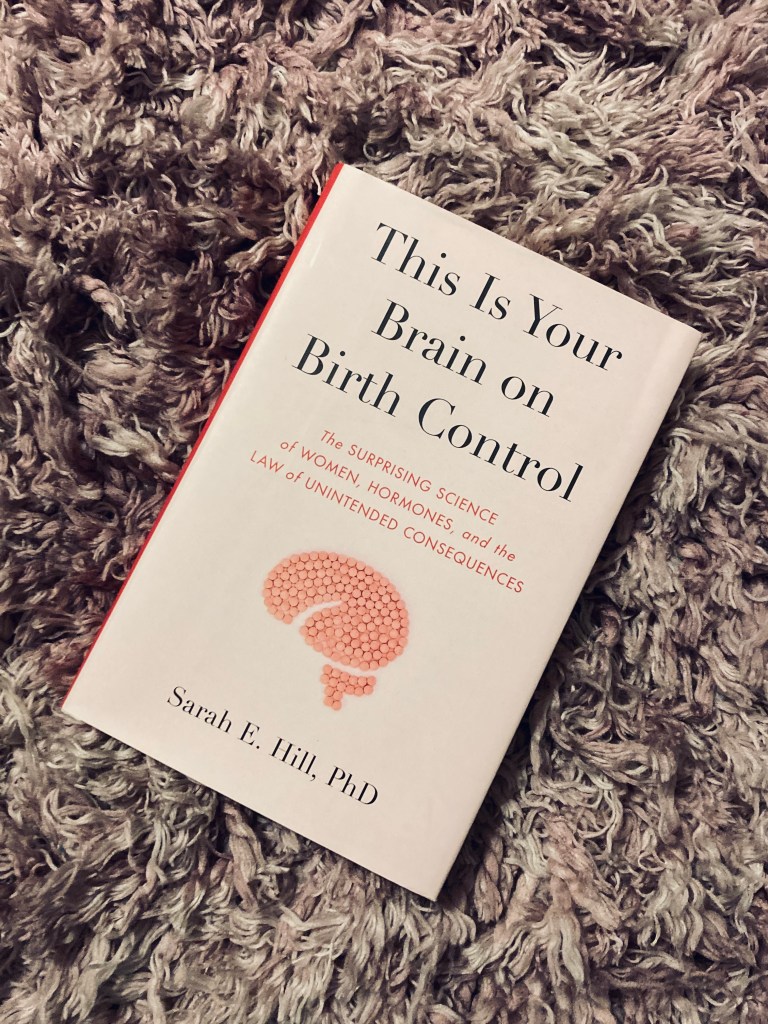
Introduction
- You are your hormones so when you change them by taking birth control you are changing the version of yourself that your brain creates
- Description of feeling off birth control: fully, vividly, awesomely, humanly alive; walking out of a two-dimensional, black and white movie into a full-color, three dimensional, meaning-filled reality
- Didn’t recognize difference in how experiencing the world until after coming off, didn’t feel anything was missing while on the pill
- Gradually coming off the page of a book and coming to life
- Feeling of dimensionality
- Experiences are shallow while on the pill
Chapter 1: What is a woman?
- The endometrium is actually a hostile environment meant to test the viability of a fertilized egg (fertilized egg must burrow through uterine wall to implant and find a blood source) (32% of fertilized eggs don’t make the cut)
Chapter 2: You are your hormones
- The version of yourself that your brain is creating right now is different from the version it would create in the presence of a different set of sex hormones
- Note interview from a man whose body stopped producing testosterone (pg 43): “Everything I identify as being me, my ambition, my interest in things, my sense of humor, the inflection in my voice, the quality of my speech even, changed…” “…it changes everything I know of myself. And it violates the sanctity of that understanding, that understanding that who you are exists independent of any other forces in the universe.”
- We think the birth control pill targets preventing pregnancy but when taking a hormone (especially sex hormone) targeted effects are not possible
- Hormones in birth control are picked up by all cells in the body that have sex hormone receptors, most notably, the brain
Chapter 3: You in the time of fertility
- Women need to have sex within 24 hours of ovulation or up to 5ish days beforehand if conception is going to happen
Chapter 4: Hormones on replay
- Pill-taking women get the same hormonal message every day
- The pill makes the brain think that it is perpetually in a cycle phase in which FSH and LH aren’t necessary
- Bedsider.org for hormone illustrations
- The pill gives a daily dose of synthetic estrogen and progestin (synthetic progesterone) that the brain reads as something close to the progesterone-dominant second half of the cycle (luteal phase)
- Can’t say that it mimics the luteal phase exactly since the hormones produced by the body differ from the hormones provided by the pill
- Synthetic estrogen (ethinyl estradiol) in the pill is synthesized from actual estrogen but the majority of synthetic progestins are made from testosterone (estradiol also made from testosterone using aromatase enzyme but body fully converts testosterone to estradiol so that is doesn’t bind to T molecules whatsoever, when progestin can)
- Since progestin still has the tendency to bind to testosterone receptors, making women more testosterone-y than women naturally are during their luteal phase
- Note for changes in journal: mood, appetite, energy, sleep, libido
- The way your body responds on the pill is specific to you: pre-pill hormonal profile, age, health, brain’s neurotransmitter profile, genes, more
- You cannot send a targeted hormonal message to one part of the body: like dropping an atomic bomb on your house to blow out a candle)
- Any hormone in the body (endogenous or exogenous) will get picked up by receptors, turning billions of switches on and off, influencing which version of yourself your body creates
- Side effects are a lie meant to make you believe that medications are more targeted than they are; medications only have effects
Chapter 5: Sexy is in the eye of the pill-taker
- The pill might blunt women’s sensory acuity in a way that renders them unable to tell the difference between men who have markers of high genetic quality and those who do not
- When estrogen is present, dendritic spines on brain cells is significantly higher (which makes sense for anxiety when estrogen is in excess)
- Super speculative, but it may be more difficult for women who meet their partners on the pill to get pregnant
- Since women’s bodies screen embryos mercilessly before allowing them to implant in uterine lining
- Women on the pill are at a greater risk of choosing partners who are genetically incompatible
- It may also be true that children born of partners chosen on the pill may be less healthy (since we tend to choose partners based on genetic variability to improve immunity)
Chapter 6: Sex on drugs
- Pill can have negative impact on sex drive because of its influence on testosterone
- T plays an important role in women’s sexual arousal and responsiveness and is necessary to synthesize estrogen, another driver of women’s sexual motivation
- Research shows that the pill can cause women’s level of free T (T the body can use) to steeply decline (61% lower)
- The pill causes ovaries and adrenals to produce less T (means less T to synthesize other hormones)
- Pill hormones cause sex-hormone-binding-globulin (SHBG) to increase, which binds to T making it inactive
- Pill might also lead to decreased concentrations of allopregnanolone in the brain, which is involved in mood and memory
Chapter 7: The curious case of the missing cortisol
- When chronic stress, the body will do everything it can to shut down the HPA axis
- Hippocampus (has more cortisol receptors than anywhere else in the brain) screams at hypothalamus to stop releasing CRH (initiator of HPA axis activity)
- Pituitary and adrenals ignore signals to release more hormone
- Liver starts releasing corticosteroid-binding globulins (CBGs) to inactivate portion of cortisol, which dampens strength of signal to the rest of the cells in the body
- Pill might cause HPA axis to go into overdrive and blunt itself
- Pill taking women exhibited ALL 4 biological markers for chronic stress
- Increased gene expression associated with cortisol signalling, high levels of blood lipids (cortisol dumps fat and sugar into blood stream), reduced hippocampal volume, attempted silencing of genes that get turned on by cortisol among those with genetic risk factor for major depression
- Higher levels of sugar and lipids in bloodstream caused by stress can increase risk of glucose intolerance (pre-diabetes), weight gain, coronary heart disease)
- Having bursts of HPA axis activity is one way our brain knows we are living meaningful lives
- Helps process emotionally complex information
- When not functioning properly, meaningful, emotional events are less able to become a part of who we are, making our lives feel flat and one-dimensional, feel emptier
- Experience become shallow
- Cortisol is a key player in inflammation management so when it is shut down, inflammatory responses can become dysregulated
- 78% of people who suffer from autoimmune diseases are women
Chapter 8: What the funk?
- Anxiety and depression involve the same brain regions, signalling pathways, respond to same treatments, tend to be found in families with either disorders
- Broken stress response might be a key player in development of anxiety and depression
- Allopregnanolone gets synthesized when progesterone is broken down and has the effect of kick-starting action by GABA receptors
- Progestin doesn’t have the same effect
- Pill decreases allopregnanolone by 79% (in rats)
- Mental-health related issues including depression and mood-related PMS symptoms characterized by low levels of GABAergic activity
- Hard to separate how hormones are making us feel from the way we see the world
- Almost impossible to tell the difference between what the hormones are doing from who we are since the pill’s hormones influence what the brain does
- It may feel like life is just crappier or jobs are harder/more stressful
- The brain can convince us that when we are sad and anxious we have always felt that way, creating the illusion of being stable and consistent over time
- Having evidence of being happy in a journal can help recognize changes
Chapter 9: The law of unintended consequences
- The desire for sex and the need to prove themselves worthy has been a powerful source of motivation for men but now that it’s not difficult to get, men are less motivated to achieve and make themselves worthy
- Men’s achievement motivation is tied to women’s standards for sexual partners but women’s is not
 moodybreadcrumbs