
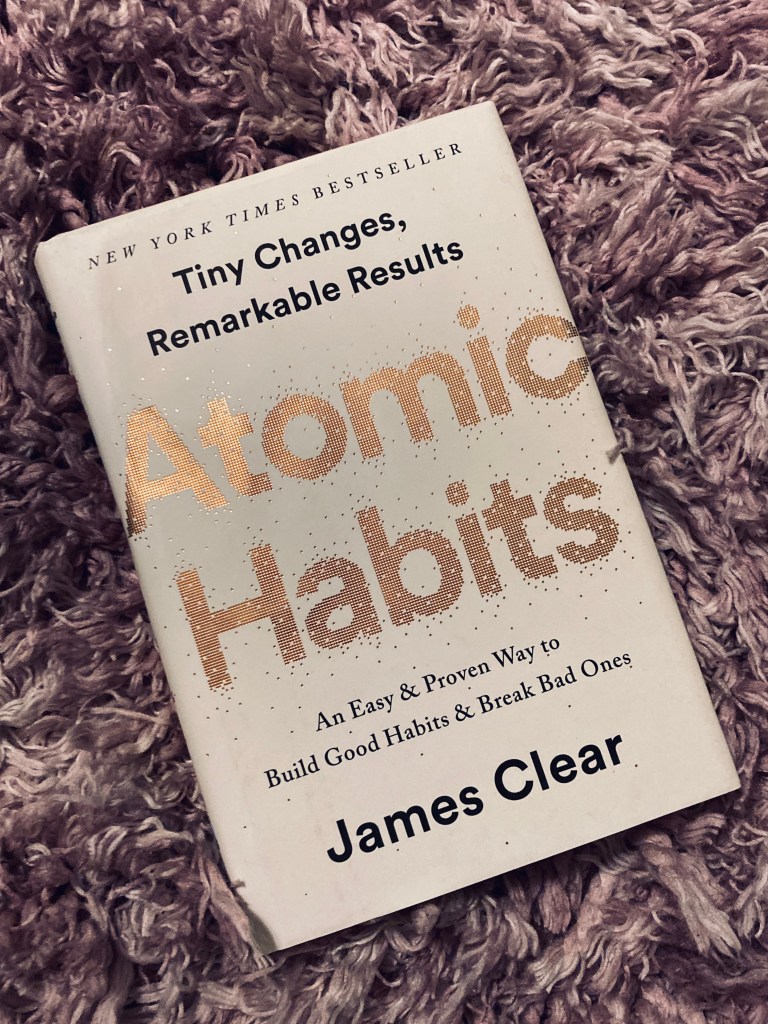
- The Fundamentals: why tiny changes make a big difference
- Breakthrough moments are the result of many previous actions that build up the potential required to unleash major change
- Expectations are that progress is made in a linear fashion but it is actually exponential with a slow incremental growth at the beginning
- The most powerful outcomes are delayed — the smallest efforts compounded over time result in powerful outcomes
- In order to make a meaningful difference, habits need to persist long enough to break through the Plateau of Latent Potential
- You have to persist until you reach the point where you actually start to make a different
- Similar to water boiling – nothing happens until you reach that exact 32 degrees
- How habits shape your identity
- The ultimate form of intrinsic motivation is when a habit becomes part of your identity – to say “I’m the type of person who is/does this”
- Your behaviors are a reflection of your identity – what you do is an indication of the type of person you believe that you are, consciously or nonconsciously (both sub- and unconsciously)
- Becoming the best version of yourself requires you to continuously edit your beliefs, and to upgrade and expand your identity.
- You only believe what your identity is because you have proof of it — meaning your actions become evidence to support that belief and the more evidence you have the more strongly you will believe it
- Habits contribute most of the evidence that shapes your identity so the process of building habits is actually the process of becoming yourself
- “Every action is a vote for the type of person you wish to become.”
- So making small improvements and building small habits is meaningful
- Each habit teaches you to trust yourself — every action becomes evidence that changes the story of your identity
- New identities require evidence and is a simple two-step process:
- Decide the type of person you want to be.
- Prove it to yourself with small wins.
- New identities require evidence and is a simple two-step process:
- How to build better habits
- 4-step model of habits/the backbone of every habit: cue –> craving –> response –> reward
- Problem phase: cue, craving
- Solution phase: response, reward
- 4 laws of behavior change evolve out of these steps
- Make it obvious
- Make it attractive
- Make it easy
- Make it satisfying
- 4-step model of habits/the backbone of every habit: cue –> craving –> response –> reward
- Make it obvious
- Automatically, the brain encodes lessons learned through experience — your ability to notice relevant cues in a given situation is the foundation for every habit you have
- You must make the unconscious conscious – the process of behavior change starts with awareness
- Strategies to get you to recognize your habits and acknowledge the cues that trigger them making it possible to respond in a way that benefits you
- Point and call can be used to raise awareness making a nonconscious habit conscious by verbalizing your actions
- Habit scorecard to list your habits/behaviors then gauge whether they are positive or negative
- However, there are no good or bad habits – they are only effective habits because you keep repeating them so they are serving you in some way
- But we can rate them by asking these questions:
- Does this help me become the type of person I want to be?
- Does this cast a vote for or against my desired identity?
- Implementation intention: make a detailed plan of when you will do the habit so that you do not put it off or wait for the motivation that never comes
- I will [behavior] at [time] in [location]
- Habit stacking pairs a new habit with a current habit that you already do reliably
- After [current habit], I will [new habit]
- Motivation is overrated; environment often matters more
- Your habits change depending on the room you are in and the cues in front of you
- Environment is the invisible hand that shapes human behavior
- Behavior is a function of the Person in their Environment or B = f(P,E)
- If you want to make a habit a big part of your life, make the cue a big part of your environment
- The most persistent behaviors usually have multiple cues, so intentionally design your environment and sprinkle triggers throughout your surroundings
- Think about behavior being defined by you in relation to your environment as opposed to the objects
- ex. if you’re faced with alcohol alone versus in a social situation, you’ll drink more in the social situation because you associate friends ordering drinks, music, seeing alcohol displayed with drinking alcohol more than you do sitting in your living room
- Habits can be easier to change in a new environment – you are more aware of your actions
- If you can’t create a new environment, rearrange the old one
- “One space, one use” – be intentional about defining separate environments for separate routines
- Your habits change depending on the room you are in and the cues in front of you
- The secret to self control
- Once a habit has been encoded, the urge to act follows whenever the environmental cues reappear
- The key to self-control is making the cues of your good habits obvious and the cues of your bad habits invisible
- Make it attractive
- Supernormal stimulus is a heightened version of reality that elicits a stronger response than usual
- i.e. junk food: sugar, processed food
- The modern food industry relies on stretching our Paleolithic instincts beyond their evolutionary purpose
- Companies intentionally design foods that have the precise combination of salt, sugar and fat that keeps humans coming back for more
- We can make habits more enticing by associating it with a dopamine response
- Whenever you predict that an opportunity will be rewarding, your levels of dopamine spike in anticipation
- Increased dopamine = increased motivation
- The anticipation of the reward gets us to take action (not the fulfillment of the reward)
- Every action is taken because of the anticipation that precedes it; the craving leads to the response
- Whenever you predict that an opportunity will be rewarding, your levels of dopamine spike in anticipation
- Strategies
- Temptation bundling: the more probable behaviors will reinforce less probable behaviors
- Capitalizes on anticipation dopamine spike
- After [current habit], I will [habit I need]
- After [habit I need], I will [habit I want]
- In other words, current habit –> goal –> reward
- ex. After I get my morning coffee, I will say one thing I’m grateful for that happened yesterday (need). After I say one thing I’m grateful for, I will read the news (want).
- Capitalizes on anticipation dopamine spike
- Temptation bundling: the more probable behaviors will reinforce less probable behaviors
- Whatever habits are normal in your culture and for the people you surround yourself with are the most attractive you will find
- We imitate the habits of three groups:
- The close
- The many
- The powerful
- One of the most effective things you can do is join a culture where your desire habit is their normal behavior
- We imitate the habits of three groups:
- Allen Carr’s Easy Way to Stop Smoking: systematically reframes each cue associated with smoking and gives it a new meaning
- You think you are quitting something but you’re not quitting anything because cigarettes do nothing for you
- You think smoking is something you need to do to be social but it’s not. You can be social without smoking at all
- You think smoking is about relieving stress but it’s not. Smoking does not relieve your nerves, it destroys them
- –> empowers you, gives you power over the smoking so that you no longer expect smoking to bring any benefits so you have no reason to do it
- **Where cravings come from – at a deep level, humans simply want to reduce uncertainty and relieve anxiety, to win social acceptance and approval or to achieve status
- Habits tend to latch onto the underlying motives of human nature
- Realizing underlying motives helps to understand and be aware of associated behaviors
- –> allows us to create new behaviors
- Your current habits are not necessarily the best way to solve the problems you face, they are just the methods you have learned to use
- Once you associate a solution with a problem, you keep coming back to it
- Habits are all about associations – they determine whether we predict a habit to be worth repeating or not
- Our behavior is heavily dependent on how we interpret the events that happen to us, not necessarily the objective reality of the events themselves
- We sense cues all the time but it’s only when we predict that we would be better off in a different state that we take action
- The gap between current state and desired state provides a reason to act
- Desire is the difference between where you are now and where you want to be in the future
- Reframing your habits to highlight their benefits rather than their drawbacks is a fast and lightweight way to reprogram your mind and make it a habit seem more attractive
- OM: Maybe more so focus on positive feelings after doing the desired habit?
- –> ex. you feel energized, proud, accomplished, strong
- Taking it a step further: create a motivation ritual to practice associating your habits with something you enjoy, then you can use that cue whenever you need a bit of motivation
- Habits tend to latch onto the underlying motives of human nature
- Supernormal stimulus is a heightened version of reality that elicits a stronger response than usual
- Make it easy
- The best way to hone your skill is to DO; put in the reps, learn and improve
- Habit formation is the process of a behavior progressively becoming more automatic through repetition
- The more your repeat an action, the more the structure of your brain changes to become more efficient at that activity
- Called long-term potentiation: neuron connection strengthening based on repetition
- There is a point at which a habit becomes automatic in the brain – at first, however, a habit requires a great deal of effort and concentration
- The more your repeat an action, the more the structure of your brain changes to become more efficient at that activity
- Our brains gravitate toward the path requiring the least amount of effort – biologically makes sense considering brain power takes up a lot of energy and the goal is to conserve energy in order to live (i.e. run away from a lion, live through a time when food is scarce, etc.)
- In habit formation, the idea is to make it as easy as possible in the moment to do things that payoff in the long run
- Also, increase friction between bad habits
 moodybreadcrumbs