
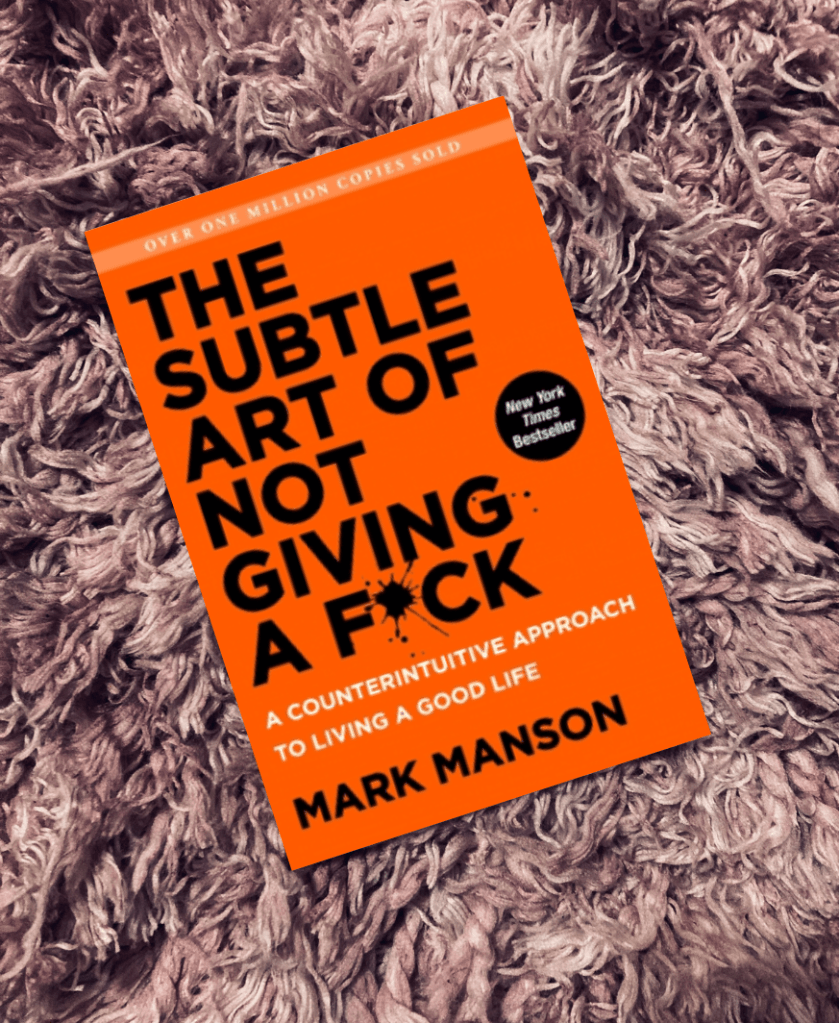
- Give less fucks
- Fall in love with the process
- Adversity and failure give us reasons to feel good about ourselves
- Entitlement causes self-absorption and concern with feeling good all the time and feeling like we should feel good all the time without deserving to feel good
Don’t try
- The desire for more positive experience is itself a negative experience. Accepting negative experience is itself a positive experience.
- The more you want something, the more you highlight the fact that you don’t have it
- You will never be happy if you’re constantly searching for happiness or the meaning of life
- Don’t try
- Suffering through your fears and anxieties is what allows you to build courage and perseverance — accept, forgive, move on
- Giving too many fucks causes you to become overly attached and to chase a mirage of happiness and satisfactions
- The key is to give a fuck about less and only to give a fuck about what is true and immediate and important *to you*
- When you give too many fucks you see every adversity as an injustice, every challenge as a failure, every inconvenience as a personal slight and every disagreement as a betrayal
- Feedback loop from hell: stop giving a fuck about how bad you feel. Accept it and move on. Otherwise, you will drive yourself crazy punishing yourself and feeling shitty about how bad you feel and how you feel bad for feeling shitty
- Society/social media communicates that having negative experiences and negative feelings is not okay
- This makes us feel overly stressed, overly neurotic and overly self-loathing because we feel like we shouldn’t be feeling that way and that our lives should be great and flawless and we feel alone and like no one else is feeling that way
- We feel bad about feeling bad
- We need to accept the fact that the world is fucked up, and it’s ok because that’s how it’s always been and how it always will be –> because we’re human and it’s a human world
- Society/social media communicates that having negative experiences and negative feelings is not okay
- Find the shit you enjoy dealing with
- The mind is always looking for potential danger, so when you have no problems, your mind finds a way to invent some
- So you need to find something important and meaningful in your life to give a fuck about, otherwise you mind will find give fucks to meaningless and frivolous things
- Suffering is inevitable, once you become comfortable with the fact that life is going to throw shit at you, you become low-key invincible and can bear anything life throws at you
Happiness is a problem
- There is no value in suffering when it’s done without purpose – man can bear any how if there is a why
- Pain and loss are inevitable so we should stop trying to resist them – if we accept that life in itself is suffering we can accept this and let it go
- Dissatisfaction and unease are necessary to creating consistent happiness
- Suffering is nature’s preferred agent for inspiring change
- We have evolved to live with a certain degree of dissatisfaction and insecurity – it’s those who are dissatisfied and insecure who are going to work to innovate and survive
- Happiness is a form of action – we need something to solve
- True happiness occurs when we find the problems you enjoy having and enjoy solving
- Negative emotions are a call to action – positive emotions are rewards for taking proper action
- Obsession and overinvestment in emotion fails us because emotions never last
- What pain do you want to sustain? What process are you in love with? These are the questions that will lead to living a happy life
You are not special
- People are afraid to accept mediocrity because they believe that if they accept it they’ll never achieve anything, never improve and that their life won’t matter
- This is dangerous thinking because it leads us to the conclusion that most of the human population (including yourself) sucks and is worthless
- The rare people who become exceptional do so because they are obsessed with improvement stemming from the belief that they are not that great at all
- Anti-entitlement
The value of suffering
- We get to control what our problems mean based on how we choose to think about them, the standard by which we choose to measure them
- If you want to change your problems, change the underlying value + metric to which success is measured –> change the metric, change the perception
- Ex. sex
- If you want to change your problems, change the underlying value + metric to which success is measured –> change the metric, change the perception
- Good values are
- Reality-based
- Socially constructive
- Immediate and controllable
- Bad value are
- Superstitious
- Socially destructive
- Not immediate or controllable
You are always choosing
- You choose your problems, you choose your situation, you can choose to change it, you can choose to change your perception
You’re wrong about everything (but so am I)
- Each individual gets to decide what is “enough” – we can choose to define everything for ouselves
- Growth is an endlessly iterative process
- When we learn something new, we don’t go from wrong to right, we go from wrong to less wrong
- We are always in the process of approaching truth and perfection but we will never reach them fully because we are not god
- There is no perfection or correctness, there is only what your experience has shown you to be right for you
- Certainty is the enemy of growth because then we shut ourselves off from other possibilities that could be closer to the truth than what we deemed to be certain
- Don’t trust you conception of positive/negative experiences – all we know for certain is what hurts in the moment and what doesn’t, which isn’t worth much
- The more you try to be certain about something, the more uncertain you will become
- Conversely, the more you embrace being uncertain, the more comfortable you will feel in knowing what you don’t know
- Uncertainty removes our judgments of others and of ourselves
- The more we admit to not knowing, the more we open ourselves up to opportunities to learn
- Manson’s Law of Avoidance: the more something threatens to change how you view yourself, how successful/unsuccessful you believe yourself to be, how well you see yourself living up to your values, the more you will avoid ever getting around to doing it
- You get comfortable knowing how you fit into the world – anything that shakes that up, even if it could make your life better, is inherently scary
- Until we change how we view ourselves, what we believe we are and are not, we cannot overcome our avoidance and anxiety – we cannot change
- Never know who you are – that will keep you striving and discovering – it will force you to remain humble in your judgments and accepting of the differences in others
- The arbitrary metrics by which you define yourself actually trap you – “finding our who you are”
- Remove inner (& outer that become inner) expectations in order to change
- Being able to look at and evaluate different values without necessarily adopting them is the central skill in changing your life in a meaningful way
- Beliefs are arbitrary and often made up after the fact to justify whatever values and metrics we’ve chosen for ourselves
- If it feels like you versus the world – it’s probably you versus you
Failure is the way forward
- If someone is better than you at something, it’s likely because they’ve failed at it more than you have
- Growth generates happiness
- Goals that are finite are not fulfilling & do not generate happiness – ongoing process-oriented goals/values that encourage improvement and progress are what truly inspires happiness
- Just as one mus suffer physical pain to build stronger bone and muscle, one must suffer emotional pain to develop greater emotional resilience, a stronger sense of self, increased compassion and a generally happier life
- Emotions do not define reality, they are worthless – we have to decode them, process them, accept them and move on
- Action isn’t just the effect of motivation, it’s also the cause of motivation
- Just start, just do, don’t wait for motivation to show itself – otherwise, you will not make progress
The importance of saying no
- Ultimately, the only way to achieve meaning and a sense of importance in one’s life is through a rejection of alternatives, a narrowing of freedom, a choice of commitment to one place, on belief or one person
- We all must give a fuck about something in order to value something and to value something, we must reject what is not that something
- To value X, we must reject non-X
- This rejection is an inherent and necessary part of maintaining our values and therefore our identity
- If we reject nothing, we essentially have no identity
- The victim creates more and more problems to solve – not because more problems exist, but because it gets the attention and affection she craves
- The saver solves and solves – no because he cares about the problems, but because he believes he must fix others’ problems in order to deserve attention and affection for himself
- Both need to take responsibility for their own problems and draw boundaries with the other
- The victim needs to take responsibility for her problems and for fixing them
- The saver needs to separate himself from the problem and draw a boundary to allow the victim to solve her own problems
- People with strong boundaries understand that a healthy relationship is not about controlling one another’s emotions, but rather about each partner supporting the other in their individual growth and in solving their own problems
- It’s not about giving a fuck about everything your partner gives a fuck about – it’s about giving a fuck about your partner regardless of the fucks he/she gives
- Without conflict there can be no trust
- Both partners must be willing to say no and hear no
- Without that negation, without occasional rejection, boundaries break down and one person’s problems and values come to dominate the other’s
- Conflict is necessary to keep the boundaries maintained and to maintain a healthy relationship
- The more options we’re give, the less satisfied we become with whatever we choose because we’re aware of all the other options we’re potentially forfeiting
- While investing deeply in one person, on place, one job, one activity might deny us the breadth of experience we’d like, pursuing a breadth of experience denies us the opportunity to experience the rewards of depth of experience
- The rejection of alternatives liberates us – rejection of what does not align with our most important values, with our chosen metrics, rejection of the constant pursuit of breadth without depth
And then you die…
- Remember we’re all going to die, so don’t take life too seriously, give less fucks about unimportant things
 moodybreadcrumbs